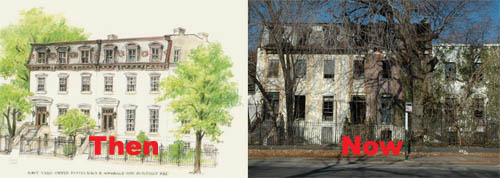
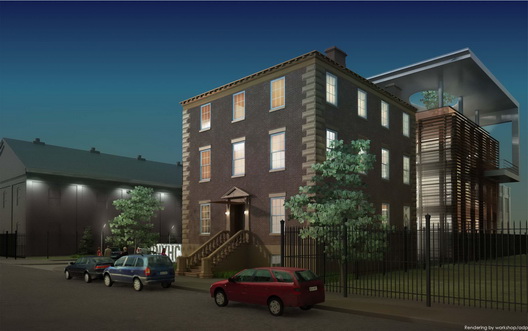
Saving a slice of Brooklyn's and America's history, we are learning, may have a very small price tag. Yet, it's one that a host of local officials seem unwilling to pay. The report that was delivered to a public meeting about Officer's Row at the Brooklyn Navy Yard on Tuesday night said that the buildings can be saved and
put the cost at about $20 million. In a city where the cost of projects now reach into the billions of dollars and public subsidies to corporations and developers run into the hundreds of millions, it is rather hard to keep a straight face when public officials protest that $20 million is simply too much money.
Why the rush to destroy a small, yet important, piece of our history? One would have to ask
Councilman David Yassky, who had appeared to have shed his anti-preservationist skin after helping to de-landmark 184 Kent Avenue in Williamsburg but appears to have relapsed, or
Borough President Marty Markowitz, who has been pro-demolition all along at the Navy Yard. Why is preservation of an asset for future generations less important than building a supermarket parking lot especially when some thoughtful planning and architecture could achieve both goals? It was rather disheartening, to say the least, to watch so many officials--including several that we respect--cast the issue in terms of jobs and groceries for low-income people vs. preservation.
We rarely say this, but in this case,
we may be lucky that the decision about whether and under what conditions to turn over Officer's Row to the city rests with the Federal Government. Perhaps, some Federal officials will see the value of preserving historic assets rather than turning them over to a local government that wishes to destroy them. One can easily see many creative solutions that would result in saving Officer's Row
and creating a supermarket. One can see these buildings being used creatively and serving as a major community asset rather than being turned into a depressing parking lot. Frankly, $20 million is a tiny sum for a city willing to put out hundreds of millions of dollars to subsidize Atlantic Yards. (One wonders, for instance, what the total subsidies in terms of grants, tax breaks and indirect benefits have been to businesses working in the Navy Yards.)
On Tuesday,
Navy Yard Development Corp. President Andrew Kimball repeated his "threat" to the Federal government that if the buildings don't come without strings attached, then the city has no interest in the land and it might end up sitting empty. To which one is tempted to say:
So be it. Perhaps the next city administration will find a creative way to use that corner of the Navy Yard to serve the community and to preserve history if the current crop of elected officials lacks the imagination and the willpower. It's not hard to imagine, given the role of the Navy Yard in American Military history, that some private patrons might even be enlisted to help save these historic buildings and write down the cost to taxpayers. (Brownstoner's analysis of the press conference and the meeting
is especially worth reading as he hits many of the most critical points in a very insightful way.)
Brooklyn has lost too much history because it's more expedient to tear things down than to find creative solutions and we have lost patience with the elected officials who, in effect, push the start button on the wrecking ball. We hope the Federal government
requires the city to find a way to save Officer's Row as a condition of giving away the land for development.
Officer's Row should be a line drawn in the sand, and if our own elected officials aren't responsible enough to be caretakers of our history--and it really pains us to say this--the Federal government should do for them. Enough is enough. Save Officer's Row so our children and grandchildren can enjoy this little piece of Brooklyn and American history instead of parking their cars on it.
[Sketch via Brownstoner]Labels: Brooklyn Navy Yard, Historic Preservation

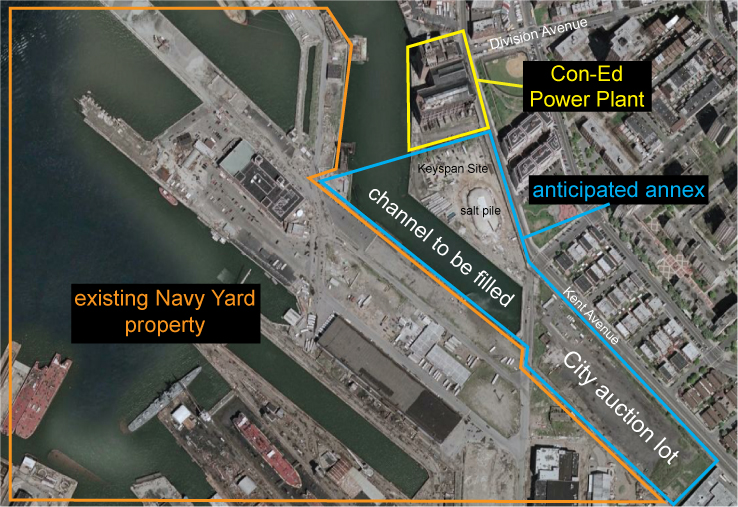 A couple of weeks ago, INSIJS exclusively reported that Con Ed may be preparing a power plant on Kent Avenue for demolition, but what about turning it over to the Brooklyn Navy Yard for preservation? "The hulking Renaissance Revival structure borders the anticipated Navy Yard annex on two sides, and fits perfectly within the wide range of existing industrial buildings on the former Naval base. The huge, high-ceilinged turbine room could host a set-building business or serve as an additional soundstage for Steiner Studios. The plant is also filled with smaller-scaled industial floors perfect for warehousing or light manufacturing. And the street side fronts directly on the sidewalk, meaning it works with the Navy Yard's proposal to include some retail frontage along the desolate stretch of Kent Avenue."--INSIJS